
The Pizza Table Test
What happens when no one is trying to win—and everyone starts learning...

Wanna listen instead? ⬆️
The place smelled like burnt garlic and Milwaukee’s Best.
One of those campus pizza joints where the tables are too close together, and nobody cares because the slices are three bucks and the pitcher is seven. It was dim enough not to notice the layer of decades-old brew on the floor, lit by a partially functional neon sign buzzing just enough to remind you this place probably wasn’t up to code.
Corner table. Back wall. Two guys and a girl. Plates pushed to the side, a half-empty pitcher between them like a referee. The girl, a second-year poly-sci major from Sacramento, had her phone face down on the table, both hands over it like a game of Jeopardy. Straight black hair tucked behind one ear, small jade studs catching the light every time she shook her head... which was often. The guy to her left, a junior from Atlanta, hadn’t come up for air in six minutes... both elbows planted and leaning on the table like he was holding it down. The third, a kid from Omaha, nursed a second slice he’d barely touched, his eyes bouncing between the two of them like a whiplashed spectator of political carnage.
They were arguing about the American justice system. Which, at a campus pizza joint on a Tuesday night, is practically small talk.
“It’s not even debatable,” the kid from Atlanta said, aggressively wiping his hands on a napkin. “Black men get twenty percent longer sentences than white men for the same crime. That’s a federal study, not an opinion. The system was built this way.”
The girl from Sacramento shook her head. “But you’re skipping over everything that happens before sentencing. Type of criminal history, plea deals... You can’t just compare outcomes without comparing inputs. That’s not analysis, that’s a headline.”
“So, the glaring disparity is what… a coincidence?”
“I didn’t say that. I said it’s more complicated than one stat.”
The kid from Omaha took a quick sip, immediately resuming his position as Chair Umpire. “I mean... can’t both things be true?”
He remained ignored.
“Here’s what I know,” Atlanta said, leaning back now, palms clinched. “My cousin did three years for possession. Three years! A guy from his dorm, white kid, got busted with more weight and did six months of diversion. Same state. Same judge. You gonna tell me that’s just ‘inputs’? That’s some straight bullshit.”
Sacramento paused.
“That’s awful,” she said. “Look, I believe you. But one story isn’t a system, and one stat isn’t a verdict. If we want to fix it, we have to actually diagnose it. Not just point at it.”
Atlanta exhaled, glanced at Omaha, then right past him. Then, instinctively, the way people do when they need someone... anyone... to back them up, he looked to the table six inches to their right.
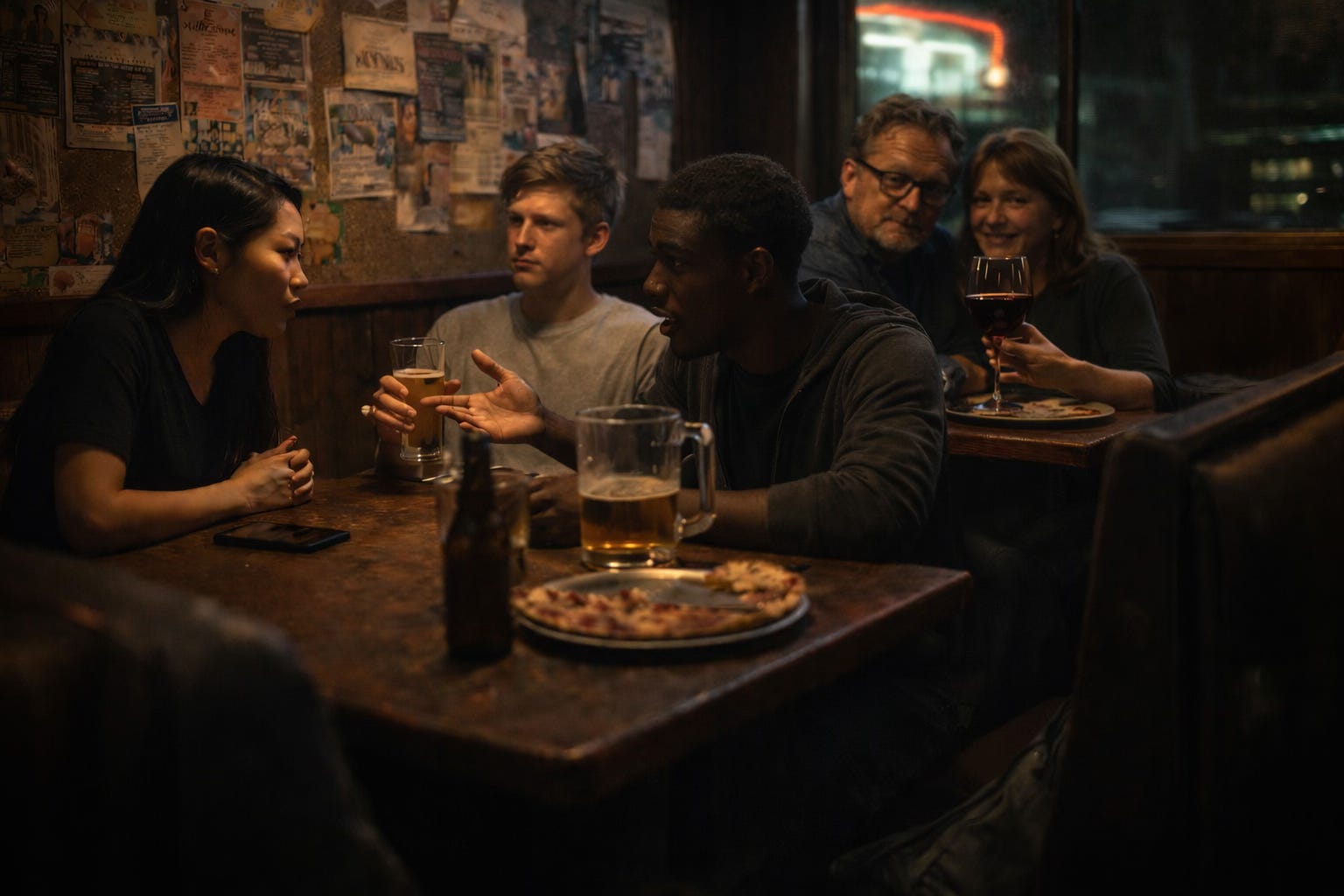
A couple. Mid-fifties-ish. Sharing a pizza they’d scarfed to crumbs. The man’s reading glasses sat atop his forehead, and a weathered canvas messenger bag hung off the back of his chair. The woman, nursing a glass of red wine, had a shit-eating grin on her face that said she’d been listening to every word without trying to.
Atlanta caught her eye. Then looked away, rapidly... as if he’d walked into the wrong public restroom.
The woman smiled. “Sorry,” she said. “Hard not to overhear. That was your cousin?”
Atlanta nodded, a little guarded.
“My brother did fourteen months,” she said. “Wrote bad checks to cover my mother’s prescriptions. Not exactly a kingpin.” She took a sip of wine. “Can I ask you something? The twenty-percent disparity you cited... do you know what it controls for?”
“Ehh, Criminal history, offense type, district, maybe.”
“That’s close. It controls for a lot. And the gap still holds, which matters. But here’s something worth looking into: Does it account for who had a private attorney versus a public defender?”
Atlanta paused. Closed his mouth.
“Your cousin... did he have a paid lawyer or a public defender?”
“Public defender.”
“And the other kid?”
“His parents hired someone.”
“So, here’s your dilemma.” She leaned forward slightly. “If a public defender is carrying 180 cases and the hired attorney is carrying twelve... how much of the sentencing gap is about race, how much is about money, and is there even a clean line between the two? I’m not asking you to answer that right now. Just sit with the fact that it may not be separable.”
“Or it’s both,” the kid from Omaha said, almost to himself.
The woman winked at him.
The man beside her, turning his water glass in slow circles, looked over at Sacramento.
“And you said we have to diagnose it, not just point at it. Okay. I’ll give you one to diagnose.” He pulled his glasses down. “1986. Congress passes a law that makes five grams of crack carry the same mandatory sentence as five hundred grams of powder cocaine. Same drug. Different form. Different neighborhoods. You know which ones. My question isn’t whether that’s fair... that part’s obvious. My question is... who was at the table when that law was written? And who wasn’t?”
Sacramento squinted.
“Ask yourself: If the ‘inputs’ you’re defending... the priors, the plea structures, the sentencing guidelines... if those were designed downstream of that law, are they neutral tools? Or are they the symptoms of the thing he’s describing?” He nodded toward Atlanta.
Sacramento exhaled slowly and pressed her palms flat on the table. “So... the inputs I’m defending as objective... some of them were possibly built on a framework that wasn’t?”
The man shrugged. “Were they? That’s not rhetorical. Go find out. Trace the legislation. Read who testified. Read who didn’t. Then come back to this conversation.”
Atlanta leaned forward. Not combatively this time. “So, you’re saying she’s wrong?”
“Well, conviction without investigation is just a louder kind of guessing.” He let that sit in pizza-joint quiet. “She asked the right question. So did you.”
Atlanta looked at Sacramento. “Alright... I hear that. When you were talking about ‘inputs,’ it felt like you were explaining it away. Like letting people off the hook.”
Sacramento’s eyes dropped to the table, then came back up. “I wasn’t. I was trying to find the mechanism.”
“I know. I get it now. You were looking for the how. I was naming the what. Same thing, different ends.”
The woman picked up her wine glass. “That’s the whole game right there.”
Omaha, who’d been watching all of this like a man taking notes he’d read later, looked at the couple. “Are you guys... professors or something?”
The man laughed and slung his messenger bag over his shoulder. A dog-eared copy of something thick with a University Press spine poked out the top. “Just two people who’ve been having this same argument for about thirty years.” He dropped forty on the table for their twenty-three-dollar bill. “You three are doing fine. You’ve moved from A to B... the rest of the alphabet will just cost you a few more pitchers.”
The woman stood, touched Sacramento lightly on the shoulder as she passed, and they walked out into the kind of night where campus streetlights make everything look like it matters more than it does.
The three kids stayed another two hours.
That, by the way, is what a university is supposed to do.
Not eliminate the disagreement, just keep the tables close enough together that you can’t help but hear the other side chewing.
The Hidden Context
Sam Richards at Penn State, commendably named one of the “101 Most Dangerous Professors in America,” teaches the largest race and ethnic relations course in the country, with 800 students and live streaming to 370,000 subscribers in 210 countries. He doesn’t tell students what to think. He asks them to consider what they haven’t. His method is radical empathy. Not agreement, just understanding. That’s the couple at the next table.
Do you believe a university should reflect specific political views rather than teach people how to develop their own?
